• 3 min de lectura
• 3 min de lectura
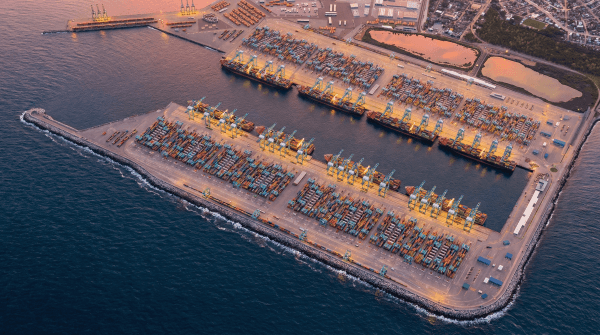
Various voices from the maritime and trade sectors have expressed their concern regarding the potential financing complications of the San Antonio Outer Port project. The concern arose after doubts generated by the Government regarding the difficulties authorities reportedly faced in securing funds from international banking institutions.
Specifically, at the last meeting of the Infrastructure Policy Council (CPI), the Biminister of Transport and Telecommunications (MTT) and Public Works (MOP), Louis De Grange, reportedly stated that, after holding meetings with different foreign banks, the results were not as expected due to the high investment involved in the construction of the breakwater (USD 1.950 million).
PortalPortuario spoke with various groups, which agreed that these types of initiatives must be approached with a long-term perspective due to their strategic nature, and that a potential postponement would affect Chile's competitiveness.
For Hugo Barra, director of the Maritime League (Ligamar), doubts about resources generate uncertainty among all participants in the country's logistics chain, stating that "we view with concern the financing difficulties that have been raised regarding the San Antonio Outer Port project. We hope and trust that the Government will make all necessary efforts to move forward with a project that, at this point, is not only important for San Antonio but strategic for Chile."
"Today, our main ports, such as San Antonio and Valparaíso, are operating very close to their operational limits. Therefore, continuing to postpone decisions on port matters could end up affecting the country's competitiveness in the coming years. Chile needs to increase its logistics-port capacity and do so with a long-term vision, as a true state policy," added Barra.
Furthermore, the director of Ligamar maintained that "it is not enough to just build infrastructure. Chile needs to advance in better coordination of its entire logistics-maritime-port system. We have good ports, good operators, and very capable actors, but we continue to operate in a rather fragmented manner. There is a lack of strategic leadership that allows for the integration of ports under a macro-zone logic and projects the country as a logistics platform for the South Pacific."
For his part, Javier Torrejón, president of the Valparaíso Regional Chamber of Commerce (CRCP), emphasized the need to address these issues from a long-term perspective.
"International trade has historically been one of the main drivers of Chile's economic growth, so timely progress in modern infrastructure with a long-term vision is key to supporting the country's future needs and sustaining its development," commented Torrejón.
Additionally, the president of the CRCP assured that the port expansion projects of Valparaíso and the Outer Port are vital complementary initiatives for both the region and the country.
"We believe that port development is a strategic matter for Chile's future growth and for maintaining the country's competitiveness in international trade. Both the San Antonio Outer Port and Valparaíso's port development play complementary roles and are fundamental to strengthening the country's logistics capacity and responding to the future challenges of global trade," concluded Torrejón.
It should be noted that, after being consulted by PortalPortuario, the acting general manager of the San Antonio Port Company (EPSA), Fernando Gajardo, confirmed that the state-owned company will finance the construction of the first stage of the Outer Port project.
Source: PortalPortuario