• 4 min de lectura
• 4 min de lectura
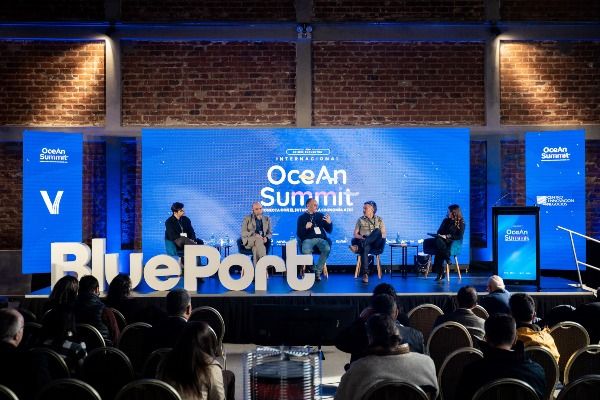
The first international Ocean Summit, driven by EIVA together with the Innovation and Business Center (CIN), the Navy's Technological Innovation Center (CiTA) and Corfo, marked a central milestone for territorial development with the official presentation of BluePort Valparaíso Region, an ambitious strategy developed over two years under the wing of the Massachusetts Institute of Technology's ecosystem acceleration program, known as MIT Reap.
During the presentation, María José Escobar, president of EIVA, and Francisco Mackay, Navy Captain and director of CiTA, outlined the comparative advantages that underpin this vision. Valparaíso not only manages 58% of the country's imports and nearly 30% of its exports, but it also stands as an undisputed digital capital by hosting Chile's largest submarine fiber optic cable network, including the future route of the Humboldt cable.
Added to this is its high talent density, standing out as the territory with the highest number of science and engineering graduates nationwide, exceeding 3,400 professionals per capita.
To capitalize on these unique conditions, the BluePort strategy structured three development pillars. These correspond to a Digital Logistics Hub, a Blue Laboratory for the sustainable use of marine resources, and a Dual-Use Platform focused on promoting technologies with both commercial and defense applications.
Furthermore, to address historical gaps such as early-stage financing, short-term initiatives were announced. These include the creation of the BluePort Smart Logistics Innovation Hub and the investment fund BluePort Valparaíso Venture Capital, projects that will become operational between 2026 and 2027.
The robustness of this approach quickly resonated with the world leaders invited to the event, whose reflections validated the immense potential of the area and gave international weight to the regional endeavor.
Jenny Krusoe, Executive Vice President of AltaSea at the Port of Los Angeles, in the United States, was categorical in analyzing the installed capacities. After learning about the ecosystem, the expert noted that "the physical port itself has many elements needed to advance innovation. They have the will, they have incredible anchor universities and incubators and accelerators working. They just need to transition to the blue economy. Valparaíso is an incredible place and already possesses the will, which is the most important thing."
From Europe, the outlook was equally promising. Lluís Miret, Professor of Applied Economics at the Universitat Politècnica de València, sized up the project and the future of the region, assuring that "Valparaíso has incomparable natural and economic conditions for the development of the blue economy and for becoming one of the great benchmarks in all of Latin America."
For his part, Javier Cubas, senior consultant at the Valenciaport Foundation, highlighted the institutional maturity of the territory. The Spanish expert stated that "there is a very well-planted seed in Valparaíso, with the entire ecosystem structure."
He also laid out the key challenge for the coming years. "What is needed now is a bit of coordination among all actors with the common goal of developing all policies linked to the blue economy. The seed is there, the teams are there, the organizations are there; now coordination is required, defining the challenges well, being accompanied by good technological companies, and acting," the expert added.
This global support was not based solely on the projections of BluePort, but on the empirical demonstration of Chilean scientific and technological talent already operating. During the various panels and business presentation spaces, prominent figures showed how national innovation is solving critical ocean problems.
Among them were the founder of Acústica Marina, Marcela Ruiz; the coastal resilience expert from the University of Valparaíso, Patricio Winckler; the director of the Copas Coastal Center, Camila Fernández; and the businessman Reinaldo Lippi.
The evaluation by the event organizers was positive. "This first edition of the Ocean Summit is a milestone that fills us with pride at EIVA. During these two days, we managed to articulate world leaders with our ecosystem, and the great value of the connections we generated lays the groundwork for the Valparaíso Region to advance in globally relevant topics. Undoubtedly, these new collaborations will translate into new development opportunities for the future," said Flavia Perazzo, Executive Director of EIVA.