• 4 min de lectura
• 4 min de lectura
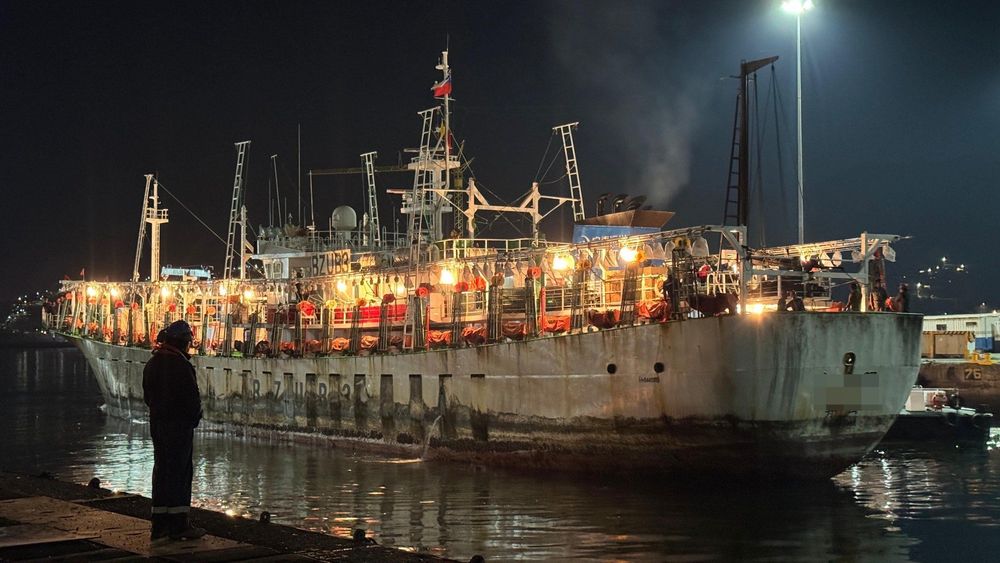
In a joint operation, personnel from the General Directorate of Maritime Territory and Merchant Marine (Directemar), the Investigative Police (PDI), the Agricultural and Livestock Service (SAG), the Seremi de Salud of the Bio Bio Region, and the National Fisheries and Aquaculture Service (Sernapesca) boarded and inspected a Chinese-flagged fishing vessel. The ship entered one of the floating dry docks of Shipyards and Arsenals of the Navy (Asmar), in Talcahuano, with the aim of carrying out repair work.
In line with what was communicated by Sernapesca, the action sought to verify strict compliance with national and international regulations governing the use of local maritime terminals by foreign fleets, at a time when these operations are under public scrutiny. No results were reported after the operation.
In the particular case of Sernapesca, it is responsible for verifying navigation histories (tracks), the transmission of satellite equipment, and the ships' holds to confirm that they match the declared fishing status. This procedure is mandatory for all units requesting entry into the country.
Although the oversight bodies did not reveal the name of the fishing vessel, a cross-reference of data on the MarineTraffic tracking platform identifies it as the Ning Tai 97 (IMO 9890305). This is confirmed by contrasting the "BZUB3" identifier visible on its hull - present in one of the photographs released by Sernapesca - with the official records of the North Pacific Fisheries Commission (NPFC).
According to NPFC records, the Chinese-flagged vessel has an official fishing authorization granted by its country of origin on July 12, 2024. This permit enables the vessel to catch squid or flying squid in international waters. Being valid until March 31, 2027, the document legally supports its extractive operations under the international regulatory framework.
In February 2026, it was revealed that Asmar provided logistical support to two Chinese fishing vessels sanctioned by the United States. Those events would date back to the first half of 2025, when both vessels called at the state company's facilities in Talcahuano while appearing on the U.S. Treasury Department's sanctions list; a scenario that, it should be noted, does not apply to the Ning Tai 97.
The inspection of the vessel occurs at a time when the Chilean fishing sector is on alert due to the massive presence of Chinese vessels at the limit of the country's Exclusive Economic Zone (EEZ). This situation had already been warned in October 2025 by the international marine conservation organization Oceana, which detected a 1,628% increase in the entry of these vessels into Chilean ports.
Chile reinforced its global commitment against illegal fishing by signing the Agreement on Port State Measures (PSMA) in 2009, an international treaty designed to prevent, deter, and eliminate undeclared and unregulated fishing.
This complements national legislation in force since 2004, which regulates the use of ports by foreign vessels through strict controls for access to the country's maritime terminals.
However, institutional data from 2025 revealed a direct impact after China's entry into the PSMA, as requests for calls by the Asian fleet experienced a drastic jump, going from eight registered in 2024 to 130 in a few months.
Given this scenario, Directemar detailed in 2025 that "once Sernapesca receives the request for port entry, as the competent authority, it reviews that the foreign vessel complies with all the requirements established by current regulations, verifying, for example, the navigation track to rule out that it has carried out fishing in national waters, and once it calls, a commission of public services is organized to inspect the vessel".
The Ning Tai 97 has an overall length of 62.4 meters and a beam of 10 meters, complemented by a depth of 6.2 meters. The vessel has a gross registered tonnage (GRT) of 1,096 tons and is equipped with an engine whose power reaches 1,471 kilowatts (kW). Likewise, for storing its catches on the high seas, the vessel has a fish cargo hold capacity of 815.08 m3.