• 4 min de lectura
• 4 min de lectura
Pierroberto Folgiero, Fincantieri's CEO and managing director, said that Carnival created the cruise business as it is today through its partnership with the shipyard.
Speaking during the steel-cutting ceremony of the new Carnival Destiny, he highlighted the companies' 30-year partnership, adding that the Arison family, which founded Carnival, invented the modern cruise industry.
"The cruise business was truly invented and nurtured by the combination of Fincantieri and Carnival over the decades," Folgiero said.
He explained that the shipyard and its past leaders interpreted the vision of Carnival's founding family, noting that the cruise business requires continued growth.
Folgiero noted that the industry is expected to grow at least 4.5 percent per year through 2030, pointing to the small share the cruise business holds within the overall tourism industry.
He said that what drives cruise growth is value for money, with similar experiences onshore costing significantly more.
"And this is driven by segmentation, which is the beauty of the story here. We collaborate throughout Carnival's portfolio of brands," Folgiero said, noting that this is a source of pride for his team.
With work and orders secured for most of the upcoming decade, Fincantieri can now concentrate on other areas, in what he called something simply unique.
"It means that we have years ahead, during which we'll concentrate on process and construction improvements, as well as client management."
Folgiero said that by celebrating 30 years of partnership and starting construction of a new vessel, Carnival and Fincantieri were "connecting two dots."
"But what is connecting these two dots is not a line. It's a learning curve because throughout this period, every single prototype has been a gate of improvement and evolution," he added.
"That's the strength of this partnership, with every ship being on top of the previous one. It's an overlapping of experiences that are stratifying one over the other," Folgiero continued.
He noted that Fincantieri delivered 76 ships to Carnival, adding that, beyond numbers, the collaboration is also an opportunity to develop people and knowledge.
"Our business is made of micro-knowledge that is stratified over time and a learning curve, prototype by prototype," he said.
"This tacit knowledge is in the hands of our workers, in the mind of our engineers and in the professionalism of our company," Folgiero continued, mentioning areas like cost control, planning and leadership.
Folgiero named Giuseppe Bono, former CEO of the shipyard, who passed away in 2022 and was credited with enhancing and strengthening the partnership between the two companies.
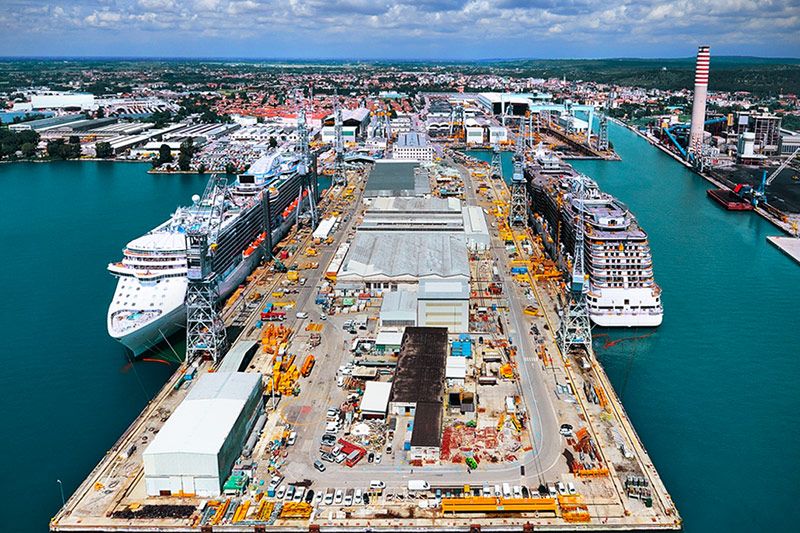
Speaking of Fincantieri's shipyard in Monfalcone, Folgiero highlighted a recent process of improving its cranes.
The company is working to replace cranes built in Germany in the 1960s with new ones recently built in Italy. He said that the new infrastructure will double the facility's lifting power, which will reach 800 tons per crane.
Folgiero noted that the change was important in allowing the shipyard to build cruise ships that exceed 200,000 gross tons.
With delivery scheduled for 2029, the new Carnival Destiny will be the first ship of this size to be built at Fincantieri.
"Thirty years ago, it sounded like an impossible mission to build a ship that wasmore than 100,000 tons," he continued, mentioning the original Carnival Destiny. "Now we are at least doubling it and targeting 230,000 with this new vessel," he added.
Set to become the largest ship in Carnival's history, the new Destiny will also be the first in the the company's fleet to exceed the 200,000-ton mark.
He said that the move marks Fincantieri's entry into the "market of jumbo cruise ships," representing an important development for the shipyard's future.
Folgiero added that, other than investing in lifting power, the company is developing technology to become what he called a high-tech business.
He said that the shipbuilding process is still driven by "kind of old-school welding and grinding processes," noting that the shipyard is investing in robotizing its production line.
Fincantieri is also investing in automation technologies to minimize low-value activities.
The move will not displace jobs but will instead help concentrate people on value-added activities, Folgiero added.
"Fincantieri has been heavily involved in a number of initiatives that are aimed at coping with the consequences of the evolution of our community."