• 3 min de lectura
• 3 min de lectura
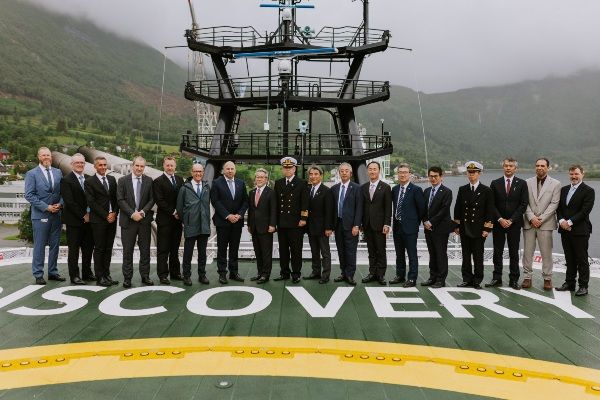
Toyo Construction held a delivery ceremony for its new self-propelled cable-laying vessel (CLV) at Vard Langsten, Norway. The ceremony was attended by representatives from Toyo Construction and the Vard Group.
The new Discovery is a fundamental asset to the fleet, leveraging the advanced shipbuilding engineering expertise that Toyo has developed over the years. It is designed to provide reliable submarine cable laying services, especially in Japan's rapidly growing offshore wind power market.
Commenting on the delivery of the new vessel, Toyo's Representative Director and President, Tatsuyoshi Nakamura, stated that "we are honored to celebrate this milestone together with Vard and the many stakeholders who have contributed to making the Discovery a reality. As we prepare to operate on a large scale in Japan, we remain committed to generating long-term value for our customers, partners, and the communities we serve."
Vard Group President, Alberto Maestrini, who also attended the ceremony, stated that "Vard is proud to deliver this complex and modern vessel to Toyo Construction. It is truly the result of a strong collaboration between Toyo Construction, Class NK, and the Vard Group, with their great skills in engineering flexibility and competencies to achieve full compliance with Japanese classification and flag, working together as one team. It will be Japan's largest purpose-built cable-laying vessel with its double capacity."
"The vessel is equipped with a detachable cable-laying system that makes it adaptable to a variety of offshore jobs, including, but not limited to, two marine cranes. I would like to express my gratitude to all the men and women who have dedicated great effort to the completion of this innovative project and congratulate Toyo Construction on its new vessel," Maestrini added.
Following its transfer to Japan and final outfitting, the vessel will be ready for full operation.
The Discovery was specifically designed to meet the challenges of Japan's demanding marine environment. Its cable tanks offer a total capacity of 9,000 tons, placing it among the largest in the country. This allows it to carry out complex and large-scale cable laying projects from start to finish.
The vessel is equipped with an advanced dynamic positioning system (DP Class 2), which ensures safe and high-precision installation, even in changing sea conditions. In addition, it can alternate between cable-laying mode and construction mode, allowing it to respond to future market needs, such as the installation of mooring systems for floating wind farms and the construction of HVDC transmission networks.
The vessel now embarks on a journey of approximately three months to Japan; upon its arrival, final preparations will be made for its operational launch in the country from the New Ishikari Bay Port, which will be the vessel's home port.