• 3 min de lectura
• 3 min de lectura
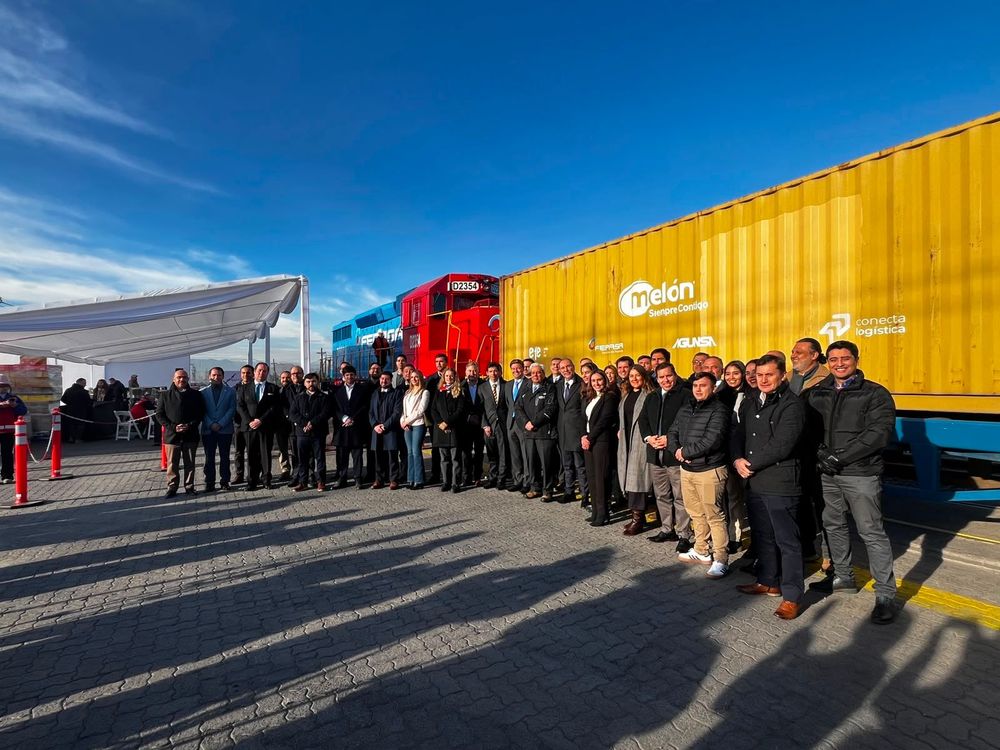
The Ministry of Transport and Telecommunications (MTT), in conjunction with the State Railway Company (EFE), Conecta Logística, and Agunsa, led the launch of an intermodal cargo transport pilot project. The objective is to move mass consumption products from Santiago to the Bio Bio Region by combining rail and trucks.
The biminister of Public Works and Transport, Louis de Grange, stated that "one of our commitments is to transport the country's wealth efficiently and safely, with the purpose of improving the logistics chain, ensuring supply in a timely manner and, of course, positively impacting people's quality of life."
"Combining the use of train and truck to move cargo is totally viable, through public-private collaborative work, and this experience is a sample of that. We hope that more companies can join this paradigm shift and thus we can continue strengthening initiatives like this in the coming years," said biminister Louis de Grange.
Through a statement, the MTT provided details of the pilot project, indicating that "the initiative will allow the mobilization of different types of cargo, including beverages, food, cement, among others, through a combined train and truck operation, covering a journey of more than 500 kilometers."
"The containers were transported in electric trucks from the companies' facilities to Agunsa's intermodal exchange center, to then continue by train to Talcahuano, where they will be transferred again to trucks to complete their final distribution," the circular added.
For her part, Mabel Leva, executive director of Conecta Logística (the institution articulating the project), explained that "the novelty of this experience is that we are seeing cargo that is not currently moved by train in a combined way; these are mass consumption goods that all Chileans see, such as CCU, Concha y Toro, and Marcopolo; products that one generally does not associate with railway movement."
"Doing this experience is proving that these mass consumption goods can indeed be transported intermodally and make our country's sustainability more sustainable," said Leva.
Meanwhile, Jorge Claude, president of EFE, emphasized the state company's commitment to continue investing to boost the country's logistics. In that vein, the head of the company highlighted that "we are making the investments so that these types of transfers can occur efficiently; for example, we have to lengthen the trains and for that we have to make longer sidings, but we are willing to do it because we see that the country needs and will need to move more cargo every day, and for that, the railway is very efficient. We must be willing and prepared for that demand that will come."
Finally, it was reported that the initiative "gives continuity to the pilot developed in 2024 between Santiago and Temuco, where 32,000 liters of beverages were transported in an intermodal railway operation that had not been carried out for more than 15 years, providing relevant learning for the development of future regular services."
One of the main expected results of this experience will be the generation of technical and operational information that contributes to the development of future intermodal solutions. For this, the Advanced Center for Transport, Logistics and Economic Competitiveness (Catlec) will monitor the operation using GPS and telemetry, in addition to evaluating the reduction of emissions associated with cargo movement.