• 4 min de lectura
• 4 min de lectura
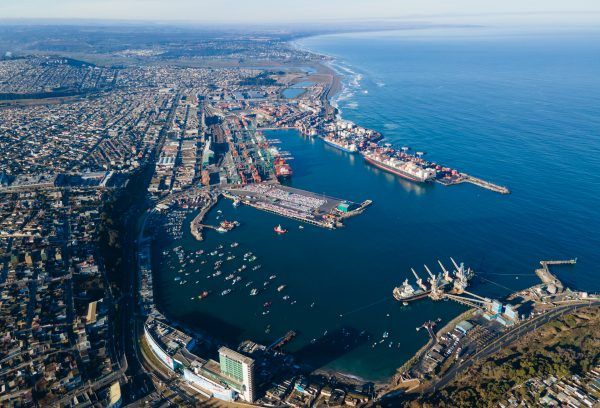
China Harbour Engineering Company (CHEC), a company prequalified to bid on the development of the San Antonio Outer Port project, established its own branch in Chile with the inauguration of corporate offices in the Marriott building, located in Santiago, Metropolitan Region.
In this regard, one of the world's largest infrastructure construction companies set up in the Chilean capital "while keeping its sights set on projects such as the San Antonio Outer Port, public transport concessions, and social housing works, among others," according to the company itself.
CHEC's branch in Chile corresponds to a structure that depends directly on the parent company and grants the South American nation "the status of a strategic hub within its expansion in the Southern Cone," according to the Chinese entity's regional division.
"With this step, Chile now incorporates its own legal structure, strengthening the company's financial and technical solidity to develop highly complex mega-projects in the region," CHEC stated.
It is worth mentioning that the company is not new to the country. CHEC debuted in Chile in 2013 with the reconstruction of the San Vicente Terminal Internacional (SVTI) pier in Talcahuano, works derived from the damage caused by the 2010 earthquake, and subsequently carried out work at San Antonio Terminal Internacional (STI).
"The qualitative leap came in 2018, when, through the concessionaire CHEC Chile Las Palmas, an entity specifically created for that project, it became the first Chinese company to be awarded a public tender in Chile: the Las Palmas Reservoir, in the Valparaíso Region," CHEC pointed out.
"Now, operationally consolidated under the new structure of CHEC's branch in Chile, the growth agenda points to two priority fronts. The first is the San Antonio Outer Port, where the company is one of the global players prequalified for breakwater and dredging works, precisely the specialties that have positioned it as one of the largest dredging companies on the planet," it added.
"The second front is social and transport infrastructure: social housing, penitentiary facilities, and railway projects, replicating in the latter case the model that currently is being implemented in the construction of Line 1 of the Bogotá Metro, a system of 23.96 km and 16 stations that, once completed, will benefit approximately 2.9 million people," the Chinese company further explained.
San Antonio Outer Port Project
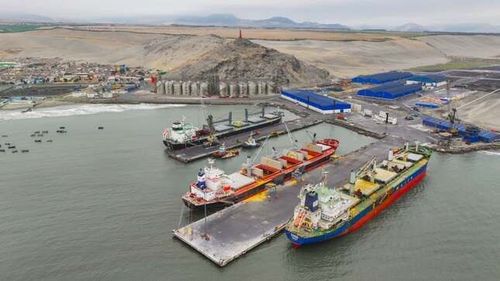
CHEC would seek to leverage the experience gained in the development of the Chancay Multipurpose Port Terminal in Peru to boost the San Antonio initiative, which recently obtained a favorable Environmental Qualification Resolution (RCA) after a unanimous approval from the Environmental Evaluation Commission (Coeva) of the Valparaíso Region.
"The credential that CHEC presents to the Chilean market is backed by global and regional-scale projects such as the Port of Chancay in Peru, designed to be a logistics hub between South America and Asia; the Fourth Bridge over the Panama Canal (with a main tower of 186 meters, the largest individual bridge built by a Chinese company in Latin America); and the Mar 2 highway in Colombia, the first public-private partnership project financed by a Chinese company in Latin America," the Chinese company stated.
"Internationally in port matters, the company built - for example - the Yangshan Deepwater Port in Shanghai, considered the world's largest container port and the smart terminal with the highest annual throughput on the planet. While, in road and rail infrastructure, it participated in the construction of the Hong Kong-Zhuhai-Macao Bridge, considered one of the seven wonders of the modern world; as well as the Second Penang Bridge in Malaysia —the longest in Southeast Asia at the time of its opening, a work that was awarded the Brunel Award by the British Institution of Civil Engineers," it added.
The tender to which CHEC is applying includes the construction of the breakwater, the dredging of the basin and the access channel; the esplanades and a railway access with two stations. The contract, which requires an investment of USD 1.950 million from the Empresa Portuaria San Antonio (EPSA), also includes work facilities and various environmental mitigation and compensation measures.
Despite doubts raised by the biminister of Transport and Public Works, Louis de Grange, regarding the financing of the project, especially concerning the funds for the breakwater, the state port company assured that it will take charge of financing the first stage of the initiative.
Source: portalportuario