• 4 min de lectura
• 4 min de lectura
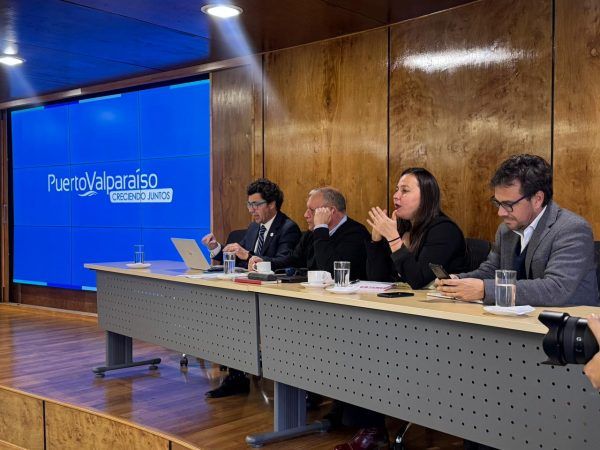
The Valparaíso City-Port Coordination Council held its first session of 2026, focusing on launching tripartite governance for the implementation of the Coastal Zone Strategic Plan (PEZC). The meeting highlighted the progress of this urban planning instrument and its move towards an implementation phase with a shared vision.
Present at the meeting, held in the auditorium of the Empresa Portuaria Valparaíso (EPV), were the regional governor, Rodrigo Mundaca, who presides over the body; the mayor of Valparaíso, Camila Nieto; and the general manager of Puerto Valparaíso, Franco Gandolfo, who serves as the Council's executive secretary. Also in attendance were representatives from public services, actors from the port logistics sector, as well as local residents and neighborhood leaders, where the PEZC's role as a strategic planning tool for coastal development was reaffirmed.
One of the main highlights of the day was the presentation of the plan's governance, which also includes a restructuring of the City-Port Coordination Council's commissions. This initiative aims to consolidate a tripartite governance model that promotes balanced and effective participation of the different stakeholders involved in coastal development.
In this vein, the session addressed progress in port expansion, city-port integration projects, such as the upcoming remodeling of Plaza Sotomayor and Muelle Prat, along with the construction of the Port Center, as well as new initiatives focused on sustainability and innovation, emphasizing the importance of maintaining a collaborative agenda for the development of Valparaíso.
Rodrigo Mundaca, president of the City-Port Coordination Council and regional governor, stated that "the Valparaíso City-Port Coordination Council is working. Barón Park will soon be a reality. Today there are ongoing developments, the commissions have been functioning. I believe that today the reality of the port of Valparaíso is different from a couple of years ago. I believe that citizen participation also indicates this."
In this regard, Mundaca highlighted that "there are many projects that are not directly linked to the port, but are contributing to it, such as the resources allocated by the Regional Government for the conservation and preservation of Plaza Sotomayor or the Immersive Museum. Also, initiatives that have to do with how we are able to transform ourselves into a logistics platform to facilitate the arrival of Argentine mining, for example, to our ports, seems important to me. And it is important because, effectively, that puts us in a different situation and condition of regional development, of harmonizing port activity with the development of cities as well. So, I'm happy, we have many challenges."
Meanwhile, Franco Gandolfo, general manager of EPV, emphasized that "today we are taking a concrete step for coastal projects to move from planning to realization, focusing on initiatives that mean direct investment in spaces for public use. The remodeling of Muelle Prat and the construction of the future Port Center reflect this commitment, allocating resources to improve infrastructure, enhance emblematic spaces, and strengthen the link between the port and the city. Within the framework of the PEZC, these investments not only aim to modernize the coastal area but also to create meeting places that are open and accessible to people, consolidating a more integrated relationship between Valparaíso and its port activity."
For her part, Camila Nieto, mayor of Valparaíso, indicated that "Valparaíso is a port city and, therefore, its development requires coordination, a shared vision, and management capacity among all involved actors. That is why we value this first session of 2026 of the City-Port Coordination Council, where we advanced in the necessary governance to promote the implementation of the projects committed to in the PEZC."
"Our objective is for these initiatives to move beyond paper and begin to translate into concrete investments that improve the quality of life of the people of Valparaíso, strengthen economic activity, and consolidate a virtuous relationship between the city and its port. As a municipality, we will continue to collaborate actively so that Valparaíso fully takes advantage of the development opportunities ahead," Nieto added.
It should be remembered that the Valparaíso Coastal Zone Strategic Plan (PEZC) is one of the commitments signed in the Agreement for Valparaíso in 2023. It is a planning instrument promoted by Puerto Valparaíso, the Regional Government, and the Municipality of Valparaíso, whose objective is to integrate port, urban, tourist, and heritage uses of the coastal area in a coordinated manner, strengthening the city-port relationship through a shared vision based on citizen participation.