• 4 min de lectura
• 4 min de lectura
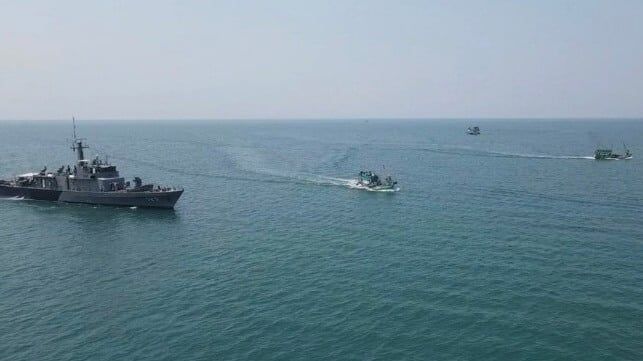
Thailand is reinforcing its maritime security capabilities in the Gulf of Thailand amid heightened tensions with Cambodia. The Thai government has ordered two C-295 maritime surveillance aircraft to strengthen its ability to monitor and control disputed waters in the region.
Tensions between Thailand and Cambodia intensified significantly in 2025 and early 2026. Last summer, conflict centered on the disputed border in Sa Kaeo, Ubon Ratchathani and Si Sa Ket provinces on Thailand's southeastern border, where Cambodian villagers attempted to claim squatters' rights and seek border adjustments. The situation became politically contentious within Thailand, with public opposition to what many viewed as excessive concessions to Cambodia. A peace agreement imposed in July of the previous year was widely perceived as too lenient, particularly after Cambodian forces were pushed back from disputed areas.
In February 2026, the situation deteriorated further. Cambodian forces were discovered laying mines on the Thai side of the border, and more critically, maritime clashes erupted. On February 9 and 12, approximately 25 Cambodian fishing boats intruded approximately one nautical mile into Thai waters off the islands of Koh Kut and Koh Klang, located at the southern end of the Khong Yai panhandle in Trat Province.
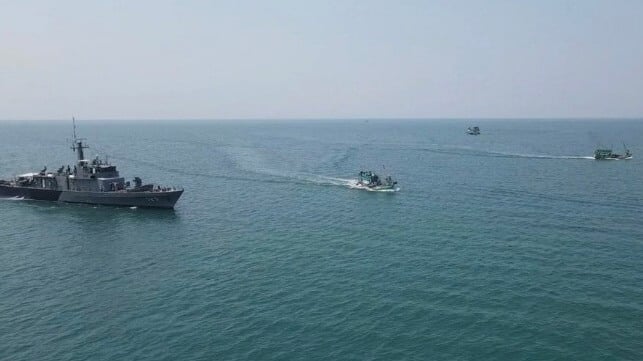
HTMS Thepha shepherds Cambodian fishing boats out of Thai waters (@warship525)
On both occasions, the Krabi Class patrol boat HTMS Thepha (P525) intercepted the fishing boats and escorted them out of Thai waters after warning shots were fired. In response, Prime Minister General Anutin Charnvirakul suspended ongoing border negotiations and withdrew previously made concessions regarding Thai territorial control of waters in the area—waters where Thailand operates producing oil fields. The border with Cambodia remains closed.
In light of these maritime clashes and election commitments to strengthen Thailand's defenses, the government has ordered two C-295 maritime surveillance aircraft. These aircraft will be based at U-Tapao near Pattaya, positioned adjacent to the disputed waters in the Gulf of Thailand, and will be operated by the Royal Thai Navy.
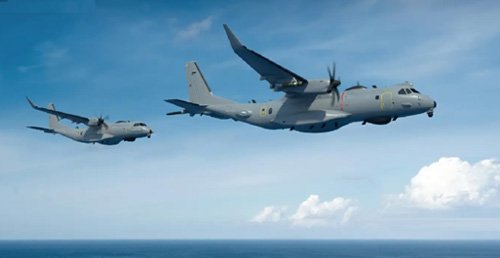
Soon to be in Royal Thai Navy colors, a pair of C-295 maritime surveillance aircraft (Airbus)
Equipped with maritime search radar and an electro-optical/infra-red sensor suite, the aircraft will provide continuous day and night maritime intelligence coverage. Thailand already operates three C-295 transport variants through the Army, with two additional C-295s on order for the Air Force.
Thailand's investment in maritime surveillance reflects broader concerns about regional maritime security and global shipping routes. The vulnerability of the Strait of Hormuz to closure has prompted regional review of other critical maritime chokepoints, particularly the Strait of Malacca, through which 30% of global maritime sea traffic passes.
Singapore and Malaysia oppose imposing transit or pilotage fees on Strait transits, a position Indonesia has now adopted after initial hesitation. However, China seeks to reduce its dependency on this chokepoint and its vulnerability to closure. China is actively sponsoring the Funan Technical Canal, which will link the Mekong River from Phnom Penh to the Gulf of Thailand through Cambodia, bypassing potentially hostile Vietnam. The canal is scheduled to open in 2028.
Thailand is developing its own alternative: the Southern Economic Corridor, still in project definition phase. Rather than a canal, the plan involves constructing road, rail, and pipeline infrastructure linked to two deep-water ports at Ranong and Chumphon. This corridor would reduce reliance on the Strait of Malacca, save 650 nautical miles and four days of sea passage, and offer significant cost advantages over Singapore's port services. For Thailand, controlling the Gulf of Thailand and waters between Chumphon and Kep is essential to the corridor's success—a goal complicated by the ongoing border dispute with Cambodia and the presence of the Chinese naval base at Ream.
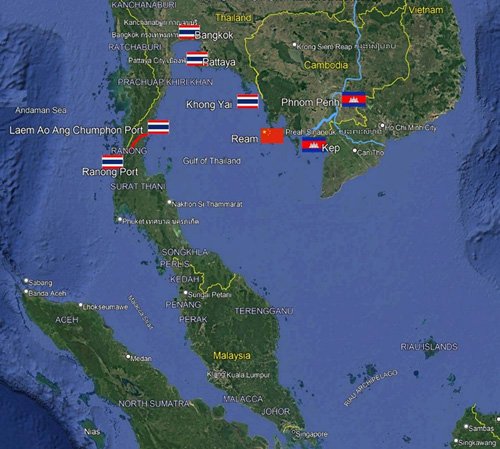
The Khong Yai area of Thai-Khmer coastal dispute, the Ranong to Chumphon Land Corridor (red) and the Funan Technical Canal shortcut from Kep to the Mekong River (blue) at Phnom Penh and thence China (Google Earth/CJRC)
Fuente: Maritime Executive