• 3 min de lectura
• 3 min de lectura
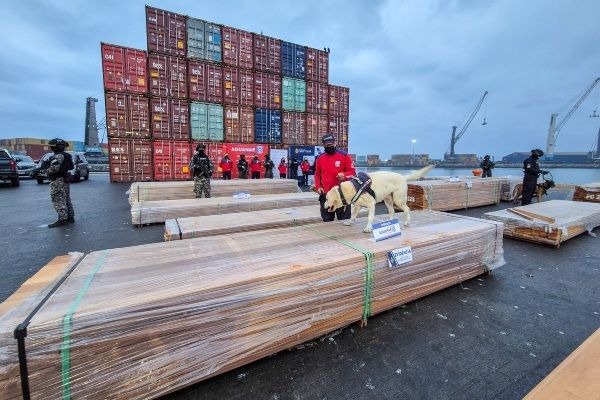
At the Port of Arica, the National Prosecutor, Ángel Valencia, and the Minister of Public Security, Martín Arrau, highlighted the investigative results of the Arica Prosecutor's Office, along with the Maritime Police, part of the Chilean Navy, and the National Customs Service, which recorded the historic seizure of 1,080.8 tons of timber impregnated with various drugs at the port facilities of Arica, San Antonio, and Valparaíso.
This represents the largest seizure in Chile's history, considering that between 10% and 20% of each detected timber load consists of illicit substances, amounting to 100 tons of drugs, primarily cocaine hydrochloride and ketamine.
The detections were achieved through cargo analysis and profiling, as well as the actions of canine units from both institutions and the use of special technologies, with each case confirmed by analyses from the Public Health Institute (ISP).
This outcome is part of an investigative focus led by the Intelligence and Organized Crime Unit of the Arica and Parinacota Regional Prosecutor's Office, related to organized crime offenses linked to the ports of Arica and Iquique.
Furthermore, it constitutes the most significant operation carried out by the Department of Maritime Police Intelligence and Investigations (Dipolmar) together with the Drug and Related Crimes Control Unit of Arica Customs, in coordination with the Navy and Customs of Valparaíso and San Antonio. After six months of investigation, this operation successfully detected 45 containers with timber impregnated with cocaine, ketamine, and other substances associated with drug processing, such as caffeine and lidocaine, used as cutting and diluting agents, as well as ecgonine methyl ester and xylazine.
These detections represent one of the most relevant investigative procedures developed in Chile regarding transnational organized crime via maritime routes, demonstrating the use of timber shipments from Bolivia as a concealment method for sending illicit substances to various international markets, mainly Germany, Belgium, France, Czech Republic, Morocco, United States, Spain, Portugal, Italy, Mexico, New Zealand, Panama, Mauritius, United Kingdom, and the Dominican Republic.
During the investigative period, a sophisticated criminal method was established, involving the chemical impregnation of illicit substances into forestry products destined for export. This method aims to hinder detection through conventional controls, utilizing advanced chemical processes that subsequently require specialized laboratories for drug extraction and recovery, while also leveraging logistical structures linked to international trade to complicate the actions of control agencies.
According to the information gathered during the investigation, criminal organizations would use Chile as a logistical platform to project contaminated shipments to strategic ports in Europe, North America, Oceania, and Africa, taking advantage of the high flow of international maritime trade and the complex logistical chains associated with foreign trade.
The illicit substances contained in the detected shipments would have allowed for the production of millions of doses destined for the international market. According to preliminary estimates based on average illicit market values in Europe, these could have generated criminal profits exceeding USD 8.334 million in European markets, considering the extraction, refinement, and distribution processes.
Likewise, it is estimated that the drugs removed from circulation through this procedure would have prevented the potential distribution of over 584 million illicit doses in different international markets, significantly impacting the operational and financial capabilities of the criminal organizations involved.
The investigative analysis also allowed for the identification of logistical and commercial patterns associated with this concealment method, including maritime routes, linked companies, export profiles, and specific characteristics of the contaminated shipments. This information is currently being further analyzed in coordination with national and international agencies specialized in combating drug trafficking and organized crime.