• 3 min de lectura
• 3 min de lectura
Arctic shipping continues to attract interest as melting sea ice and geopolitical disruptions push companies to explore faster trade routes between Asia and Europe, but Allianz Commercial warned the region remains one of the highest-risk environments for commercial shipping.
In its Safety and Shipping Review 2026, Allianz said economic activity in the Arctic has expanded rapidly, with the region's gross regional product nearly tripling between 2003 and 2022 to $666 billion as investment, resource development, and shipping activity increased.
The insurer highlighted growing interest in Russia's Northern Sea Route (NSR), which runs along the country's Arctic coastline and can significantly reduce voyage times between Asia and Europe compared with traditional routes through the Suez Canal.
"We have seen ships transit the northern sea route from China to Europe in just over 20 days, compared with 40 days via the Suez Canal and 55 days around the Cape of Good Hope. Time is money, and we could see more shippers use the NSR due to competitive pressures," Captain Anastasios Leonburg, Senior Marine Risk Consultant at Allianz Commercial, said in the report.
The first commercial voyage along the Northern Sea Route was completed in 2009 by Germany's Beluga Shipping, while Danish shipping giant Maersk conducted the route's first container ship transit in 2018 with the Venta Maersk.
According to Allianz, 2025 marked another milestone for Arctic shipping. The report noted the first China-Europe container ship transit via the NSR in just 22 days, while transit cargo volumes reached a record 3.2 million metric tons and container voyages increased to 23 from 15 a year earlier.
Yet Allianz cautioned that the route remains far from mainstream.
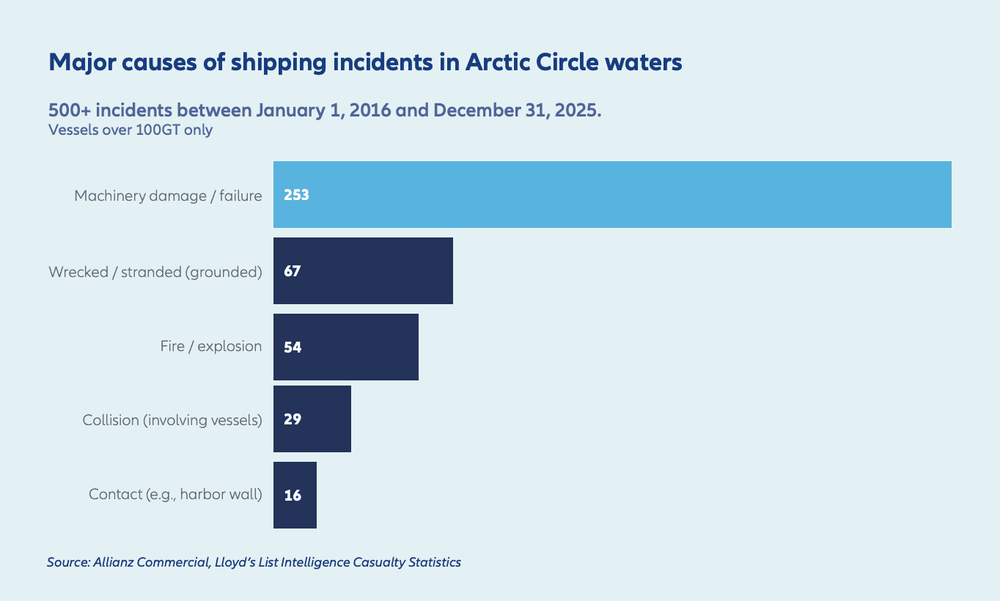
"Interest in Arctic shipping has heightened, driving demand for ice class vessels and icebreakers and more skilled crew members. However, navigating polar waters is inherently risky due to the harsh conditions and remoteness of the region," Captain Rahul Khanna, Global Head of Marine Risk Consulting at Allianz Commercial, said. "Any incident will be enhanced in severity and potentially have a larger environmental impact."
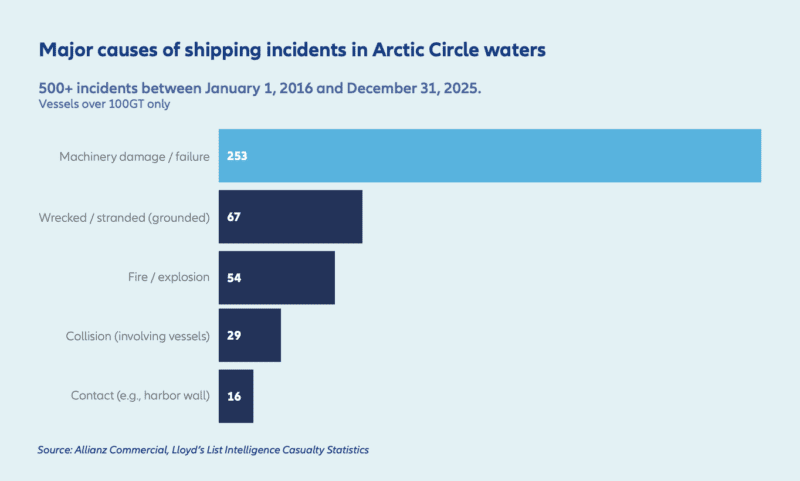 Major causes of shipping incidents in Arctic Circle waters (Source: Allianz)
Khanna also pointed to the growing role of sanctions.
"Should a vessel get into trouble and require assistance or services provided by the Russian state or companies, the situation is also complicated by sanctions," he said.
Those sanctions have become a significant obstacle for international operators. Following Russia's invasion of Ukraine, the diversity of shipping on the Northern Sea Route has collapsed, with Russian and Chinese vessels now accounting for approximately 95% of transit traffic. Many Western operators have largely stayed away, in part because Russia's nuclear icebreaker operator Rosatomflot has been sanctioned, complicating access to escort services often required for Arctic navigation.
The report warned that limited infrastructure, sparse search-and-rescue capabilities, difficult salvage operations, and environmental risks continue to constrain wider adoption. Allianz also said growing competition among major powers for control of Arctic trade routes and resources could create future geopolitical flashpoints.
Nevertheless, interest continues to spread. South Korea is preparing its first container ship voyage through the Northern Sea Route this summer as part of a broader effort to establish regular Arctic-Europe services. Seoul also aims to develop Busan into a major Arctic shipping hub, viewing future Arctic trade as a potential economic growth engine for South Korea's southern port regions.
The route's future will ultimately depend on the interplay of economics, geopolitics, sanctions and risk, Allianz says.
Fuente: GCAPTAIN_NEWS