• 4 min de lectura
• 4 min de lectura
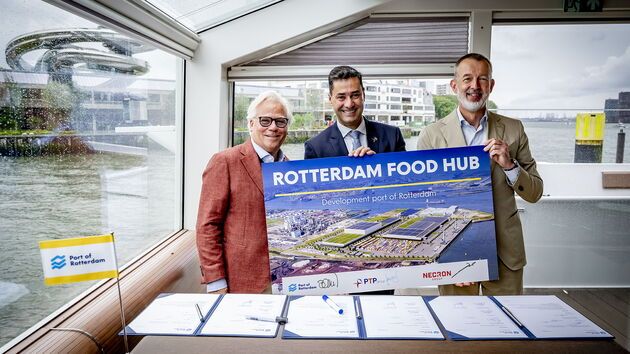
Port of Rotterdam Authority, Necron Group and PTP Group are developing 38 hectares of logistics infrastructure in Europoort for the storage and transhipment of chilled and frozen agrifood products, including a new quay wall, various warehouses and terminal facilities. The development also includes its own energy supply. To this end, the parties have signed the issuance agreement. With this expansion, Rotterdam is strengthening its role as a European gateway for these cargo flows.
For the Port of Rotterdam Authority, the project forms part of the ongoing development of the Rotterdam Food Hub as a logistics hub for the (agri)food sector. To this end, the Port Authority is constructing a quay wall over 500 metres long. Additionally, a breakwater is being constructed to protect the moorings from waves coming in from the sea and from passing ships.
According to Boudewijn Siemons, CEO of Port of Rotterdam Authority, the project highlights the importance of the Rotterdam Food Hub: "At this strategic location, we bring together logistics, warehousing and infrastructure, enabling our customers to handle their freight more quickly, sustainably and efficiently. With this development, we are taking an important step towards further strengthening our position as Europe's leading agrifood port."
The plan comprises four plots. Necron Group is constructing two cold storage and freezer warehouses – Necron Food Park I & II – in phases on two plots, with a total surface area of approximately 145,000 m². The facilities are designed for cold-store operators and are aimed at meeting the growing demand for efficient and scalable cold chain solutions in Europe.
Part of the plan involves the construction of an energy hub by Necron Group on the third plot, in the southern part of the Rotterdam Food Hub. This supplies the terminal and the cold stores with power from the outset, enabling them to be put into operation immediately. According to **Gerard van Liempt, CEO of Necron Group: "With this development, we are creating logistics real-estate for the storage and transhipment of chilled products, combined with our own energy supply. Drawing on our experience with food and cold chain projects, we can immediately facilitate large-scale and efficient operations at this site."
Logistics provider PTP Group is developing the associated 73,000 m² terminal on the fourth plot along the Calandkanaal. This terminal will have three berths for deep-sea and inland shipping vessels, along with a waiting area and the necessary logistical and infrastructural facilities to ensure the efficient, water-based handling of cargo flows. Among other things, the terminal is designed to serve the cold stores and handle additional cargo, and it enhances multimodal access to the area. Additionally, PTP will become one of the tenants of the Necron Group's cold storage and freezer warehouses.
Guillermo Misiano, CEO of PTP Group, emphasises the operational significance of the development: "Con este terminal, reforzamos nuestra posición como proveedor de servicios portuarios y logísticos en Europa. Estamos creando un enlace directo entre el muelle, el almacenamiento y el transporte. Esto permite un mayor uso del transporte marítimo y fluvial y reduce los tiempos de procesamiento de los flujos agroalimentarios."
Over the coming period, the parties will finalise the engineering details and apply for the necessary permits. This is expected to lead to the final investment decisions by the Necron Group, the PTP Group and the Port of Rotterdam Authority in early 2027.
The Rotterdam Food Hub is located on the 'Kop van de Beer' site in the western Europoort area, near the entrance to the Maasvlakte. The area is being developed for businesses in the agrifood sector, with direct quay access to facilitate the efficient handling of chilled and frozen cargo, particularly from South America. The Rotterdam Food Hub is designed around the principle of 'security by design', with the layout and processes at the terminal being developed in close collaboration with customs. This ensures that shipments from Latin America can be processed in a controlled, secure and efficient manner. With this development, Rotterdam is strengthening its position as Western Europe's largest transhipment port for products from the agricultural, horticultural and fisheries sectors.
Fuente: Port of rotterdam