• 3 min de lectura
• 3 min de lectura
U.S. forces have disabled another tanker near the Strait of Hormuz, according to U.S. Central Command, bringing the total tally to six vessels.
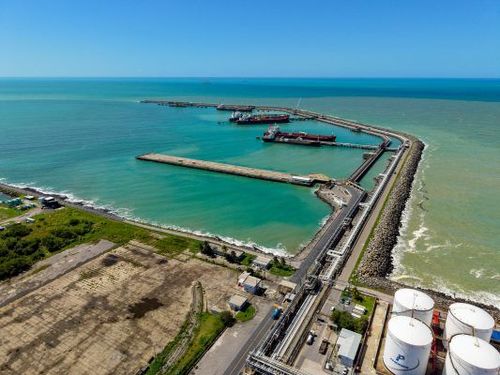
On June 2, Centcom forces observed the stateless tanker Lexie transiting towards Kharg Island, one of Iran's primary loading terminals for oil exports. Empty tankers provide the potential for Iran to extend its production capacity through floating storage, and Centcom has attempted to prevent this by blocking inbound traffic, with substantial success.
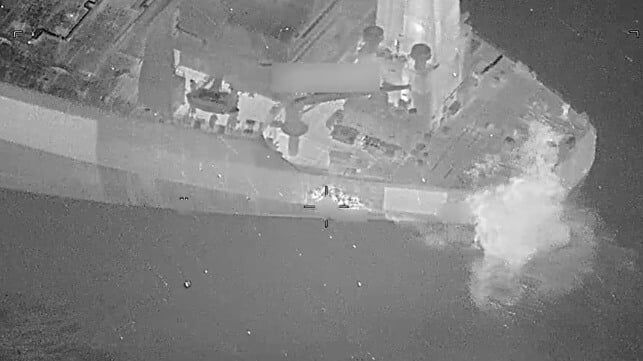
According to the command, U.S. forces repeatedly ordered Lexie's crew to halt their transit, but the tanker ignored the warnings for 24 hours. To bring the vessel to a stop, a U.S. aircraft launched a small Hellfire guided missile at the Lexie's engine room, disabling the vessel and preventing her from reaching Iran. As in several previous Centcom blockade-enforcement strikes, official video footage shows no sign that the tanker was making way towards a destination at the time of recorded impact.
It was the sixth Iran-linked ship that Centcom has disabled to date, and the strike adds to a series of exchanges of fire between U.S. and Iranian assets that have persisted over the past week. A ceasefire between the two sides remains in effect.
Lexie (also"Lexi," IMO 9203277) is a 300,000 dwt crude oil tanker built in 2001. She falsely claims to be registered with the flag state of Botswana, according to her Equasis record; the landlocked African nation does not have an international ship registry, but has been frequently used as a false flag by "shadow fleet" vessels like Lexie. The ship has a long history of false flagging, having previously claimed to be registered in the Comoros Islands and Samoa. She is sanctioned by the U.S. government for involvement with the Iranian oil trade and by Ukraine for involvement in the Russian oil trade.
AIS data provided by Pole Star Global shows that Lexie has spent much of the past three months operating in the dark, with her transponder likely turned off. When visible, she has been broadcasting a location at the northern end of the Gulf of Oman, near the Strait of Hormuz and Kharg Island. Her position was last received last week, on May 26.
Separately, the sound of multiple explosions were reported on Qeshm Island early Wednesday. Qeshm is an important basing location for the Islamic Revolutionary Guard Corps (IRGC), which is the primary enforcer of Iran's selective blockade in the Strait of Hormuz. Official outlet Mehr News reported residents' accounts of the blasts, but did not provide additional information.
Meanwhile, Kuwait reported the activation of its air defenses, marking the third time in a week that Iran has launched a missile attack on targets inside the small country - notably the Ali Al Salem Air Base, home to American military units.
U.S. Central Command confirmed Wednesday morning that its forces had shot down multiple Iranian ballistic missiles and drones overnight, and had hit targets on Qeshm Island in "self-defense" retaliatory attacks. Two missiles launched at Kuwait failed in flight, and three more launched at targets in Bahrain - home of U.S. 5th Fleet - were intercepted, the command said. In addition, U.S. forces shot down three suicide drones that Iranian units had launched toward civilian ships, according to Centcom.
Fuente: Maritime Executive