• 3 min de lectura
• 3 min de lectura
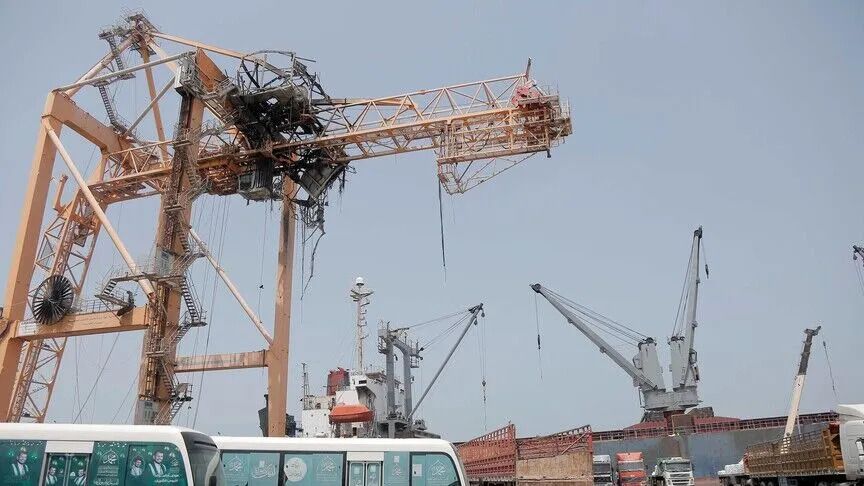
The President of Yemen's Presidential Leadership Council, Rashad al-Alimi, described the attack perpetrated by the Iran-backed Houthi group against the Port of Mocha – near the Bab al-Mandab strait – as an "extension of Iranian escalation" against economic facilities and maritime routes.
At least seven people were killed and another 35 injured in drone and missile attacks launched by the Houthis against the port complex and residential neighborhoods, west of Taiz province, in the early hours of Sunday, August 9.
"The attack on a vital seaport near Bab al-Mandab is an extension of Iranian escalation against economic facilities, maritime routes, and the interests of countries in the region," Alimi stated during a meeting with the new US Chargé d'Affaires to Yemen, Neil Hope, as quoted by the official Saba news agency.
The offensive "once again demonstrates the danger of missiles, drones, and advanced weaponry capabilities remaining outside the authority of the state," he added.
During the meeting, Alimi informed the US diplomat about the evolving situation on the ground in Yemen, according to Saba.
Alimi noted that Sunday's attack on August 9 came days after "Houthi aggressions against armed forces positions, displaced persons camps, and civilian assets," as well as attempts to attack ships and national facilities.
He accused the Iran-backed group of waging "a systematic war against the resources of the Yemeni people, their livelihoods, and their economic outlets."
"The Houthi militias, who claim that areas under their control suffer from a blockade, are the same ones who today attack ports, airports, and economic facilities, threatening commercial vessels and the supply of food and fuel," Alimi declared.
The Yemeni leader urged the US and the international community to move "from merely containing the Houthi threat to neutralizing its sources and tools," by maintaining political, economic, and diplomatic pressure on the group and its sponsors, while strengthening the capabilities of the Yemeni government.
The Yemeni president reiterated the government's support for "any diplomatic effort that reduces tensions and prevents wars in the region," but warned that agreements that do not address the military capabilities, financing, and regional threats of Iran-backed groups "will only postpone the crisis instead of resolving it."
"Sustainable security cannot be built in the region as long as armed groups exist that are capable of deciding to go to war, launch missiles and drones, and threaten international waterways independently of state institutions and sovereignty," he added.
Mocha, one of Yemen's main seaports, is located near the Bab al-Mandab strait, a strategic maritime choke point connecting the Red Sea to the Gulf of Aden. The port is under the control of Yemeni government forces.
Sunday's attack on August 9 came days after the Houthis claimed on Wednesday, August 5, to have hit the Saudi oil tanker Wafaa with several ballistic missiles in the northern Red Sea, off the coast of Yanbu.
Houthi military spokesman, Yahya Saree, maintained that with this attack, the number of Saudi oil tankers hit since July 22 had risen to eight, also asserting that another 29 had been prevented from passing through the Red Sea and the Arabian Sea or had been forced to turn back.
Clashes have periodically intensified on several Yemeni fronts since last month, leaving dozens dead and wounded on both sides.
Yemen had been in relative calm since April 2022, after nearly 12 years of war between government forces, backed by a Saudi-led coalition, and Iran-backed Houthis, who took control of the capital, Sana'a, and large areas of the country in 2014.