• 3 min de lectura
• 3 min de lectura
AIDA Cruises has detailed several initiatives it employs in order to improve ship operation efficiency.
They include expanded shore power use, increased adoption of biofuels and advanced digital solutions.
Biofuels
After biofuel was first used onboard the AIDAprima in summer 2022, the LNG-powered ships in the fleet are being prepared for the future use of additional biofuels and e-fuels as soon as they become available in sufficient quantities.
In 2025, more than 8,500 t of ISCC EU-certified Bio LNG were supplied to the AIDAnova in the ports of Hamburg, Kiel and Zeebrugge, according to Dirk Inger, senior vice president public affairs, communication & sustainability at AIDA Cruises.
The company said it is also working with partners from science and industry to prepare for the future use of e-fuels onboard its vessels.
Examples include participating in research and development activities focused on innovative energy conversion and storage technologies based on renewable ammonia as well as developing hydrogen as a fuel for future combustion engine-based marine propulsion systems and evaluating the implications of integrating such technologies into cruise ships.
"However, several challenges remain for the broader adoption of e-fuels, including fuel availability in ports, industrial-scale production capacities, internationally harmonized regulatory frameworks, and the lack of commercially viable pricing structures in Germany and Europe," Inger added.
Shore Power
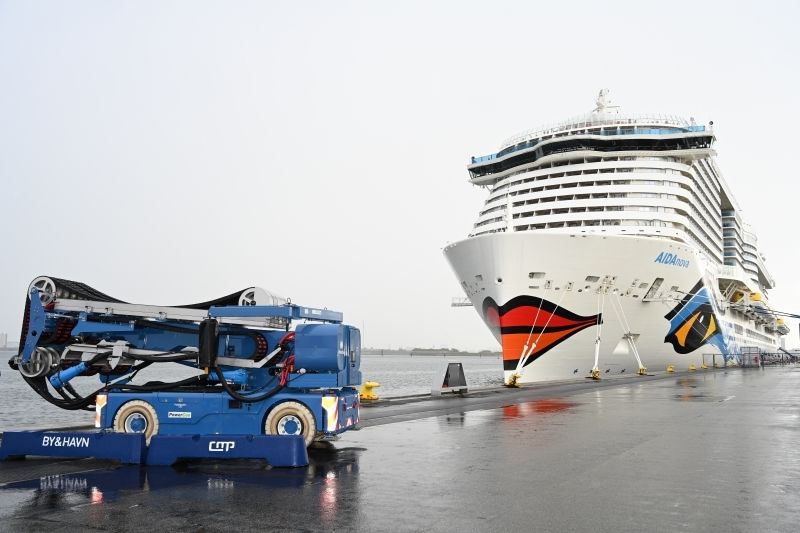
In 2017, the AIDAsol became the first cruise ship to regularly use shore power in the Port of Hamburg through Europe's first shore power facility for cruise ships, located at the Cruise Center in Altona.
Since then, AIDA Cruises has continuously expanded the use of shore power, resulting in 340 shore power connections in 2024 and 440 in 2025.
The company is currently planning around 540 shore power calls for 2026 with its vessels.
Shore power is available in 17 European ports, including Hamburg, Warnemünde, Kiel, Southampton, Bergen, Oslo, Stockholm, Rotterdam, Copenhagen, and Le Havre, among others.
This represents approximately half of all AIDA port calls on Northern European itineraries departing from Germany.
Digital Energy Management
Reducing energy consumption is said to be a key component of the company's technical fleet management strategy, and all ships in the fleet are equipped with integrated energy management systems that are connected to a group-wide data platform.
Digital applications, machine learning and artificial intelligence are used to analyze operational data and identify further optimization opportunities.
AIDA underlined EOS (Energy Optimization System), a digital analytics system, which has been gradually implemented across the AIDA fleet since 2023, as one of the most important investments in this area.
Incorporating variables such as weather and wind conditions, vessel and engine models, and the number of guests onboard, EOS assists crews in making operational decisions in real time, such as optimizing onboard energy flows or calculating routes designed to minimize energy demand.
The system has been shown to significantly reduce energy requirements for propulsion and various onboard systems, AIDA noted.
AIDA Innovation Hub
As part of the application phase for the new AIDA Innovation Hub, start-ups, tech companies, industry partners and scientific and research institutions were invited to submit their ideas for smart solutions in the fields of decarbonization, sustainability and AI tools.
The company received more than 150 potential ideas, which will now be reviewed and the shortlisted projects will be presented to an expert jury in Rostock on September 16, 2026.
The winners will have the opportunity to further develop their ideas together with AIDA through implementation studies or test them as a pilot project onboard AIDA vessels.