• 3 min de lectura
• 3 min de lectura
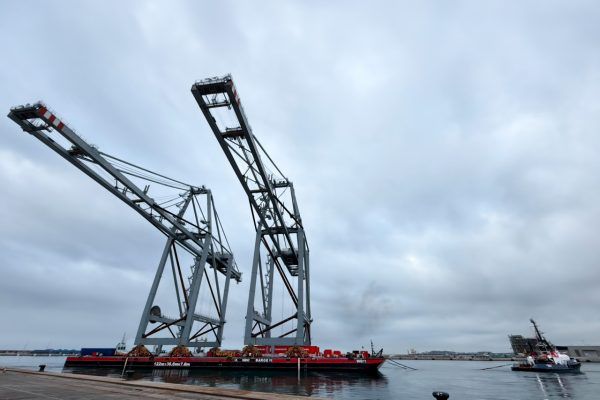
The Andalusia dock at the Port of Tarragona bid farewell last week to the two large Super Post-Panamax cranes from DP World that remained, in a highly complex operation carried out over four weeks. With this move, the way is now clear to prepare for the arrival of the joint venture between PTP and Cosco, which will manage this space designated for containers and general cargo.
Between 25 and 30 people worked for more than 30 days at the Andalusia Dock to carry out the removal of the two Ship-to-Shore (STS) cranes. The operation was coordinated by Wagenborg Towage Iberica SLU as the main contractor.
Weighing approximately 1,350 tons per crane, work began on April 28 with preparation and structural reinforcement tasks. The loading phase, executed using self-propelled modular vehicles (SPMTs), took place between May 18 and 20. The platform departed from the Tarragona facilities last Saturday, June 6, aboard the Wagenborg Barge 11, which is 122 meters long, towed by the vessel VB Brent, once safe weather conditions were confirmed.
To guarantee the safety of the operation, the Port of Tarragona applied total navigation restrictions of 6 hours during each loading maneuver, accompanied by strict risk prevention and marine environment protection protocols.
The Port of Tarragona is preparing to write a new chapter in its history. The joint venture formed by operators from the Cosco and PTP groups has been awarded the management of the new multi-purpose terminal.
The new terminal will occupy a minimum area of 226,109 m², expandable up to 452,218 m² depending on the project developed. The facility is designed to move high-value goods, such as containers, vehicles, or special cargo, and must reach a minimum of 125,000 TEU annually starting in 2031. The objective is to attract quality logistics activity and generate skilled jobs.
This project is a key step in the Port of Tarragona's strategy to diversify its activity and strengthen its role as an intermodal, competitive, and sustainable logistics hub. The Port Authority has found in this joint venture a global operator with real driving capacity, a long-term vision, and alignment with the Port's strategy, based on traffic diversification, the promotion of rail as a structural axis of connection with the hinterland and Europe, and the evolution towards a Port 4.0 supported by the green transition, innovation, and digitalization. The new terminal will be integrated into a robust intermodal system that includes the La Boella railway terminal, the Guadalajara-Marchamalo dry port, and the Logistics Activities Zone.
Source: portalportuario