• 4 min de lectura
• 4 min de lectura
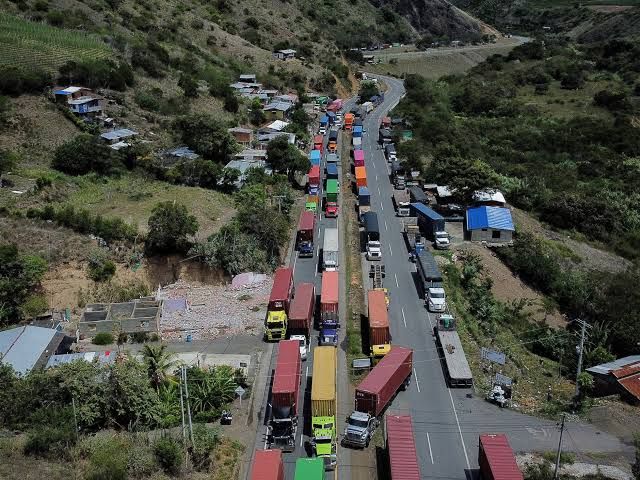
The Inter-union and Inter-business Committee of Buenaventura has made progress on an agreement aimed at alleviating the congestion that occurs on the roads and accesses to the port area.
The entity signed the pact with the Colombian Ministry of Transport, the National Infrastructure Agency (ANI), the Superintendence of Transport, the District Secretariat of Traffic and Mobility, the concessionaire Unión Vial Camino del Pacífico, port terminals, transport guilds, the Buenaventura Chamber of Commerce, and representatives of the business sector.
During the meeting, the idea of building an emergency plan to address the immediate situation while advancing towards structural solutions was consolidated.
"Beyond the exchange of positions regarding the causes of congestion, the main result was achieving a consensus among stakeholders who have historically approached the problem from different perspectives, allowing us to move from diagnosis to the definition of concrete measures to restore mobility in the port corridor," stated the CIB.
The President of the Board of Directors of the Inter-union and Inter-business Committee of Buenaventura, Franklin Ruíz Palacios, called for a change in the way this problem has historically been addressed.
"None of us here are completely oblivious to this situation. We are all part of the operation of Buenaventura's road and port infrastructure, and we all have some degree of responsibility. If we continue to meet only to point fingers, the problem will remain exactly the same," he said.
Ruíz Palacios explained that the current crisis responds to a situation that goes beyond a single actor and recalled that Buenaventura mobilizes nearly 5,000 vehicles daily, which is why any interruption of the corridor generates a cumulative effect that can take three to four days to normalize, even if the blockage lasted only a few hours.
The president of the CIB also warned that pressure on the infrastructure will continue to increase due to the sustained growth of Colombian foreign trade.
"Buenaventura will continue to grow between 10% and 12% annually in cargo movement. Port terminals have the capacity to respond, but the complementary road and logistics infrastructure needs to evolve at the same pace. That is the fundamental discussion that we, as a country, must undertake," he affirmed.
Likewise, the leader called for each institution to fully exercise its corresponding responsibilities.
"The concessionaire must execute the works efficiently; the Ministry of Transport, ANI, and traffic authorities must coordinate the necessary actions to minimize impacts; and the private sector also must continue to provide solutions. Only by working together can we overcome this situation," he expressed.
Following the meeting, an immediate roadmap was defined to reduce congestion while road intervention continues. In this regard, it was agreed to temporarily suspend works in the La Caucana sector during Friday and Saturday, after re-enabling vehicle passage, and resume work on Sunday with the aim of concluding the intervention at that point before moving on to the next work fronts.
It was also established to maintain permanent monitoring of mobility behavior and the logistical operation of the corridor, reinforce coordination between the concessionaire, traffic authorities, and port stakeholders to immediately address any new contingency, and continue developing technical tables to define structural solutions for access to Colombia's main Pacific port.
The Inter-union and Inter-business Committee of Buenaventura highlighted that the greatest achievement of this day was getting all entities with direct influence on the corridor's mobility to participate in the same conversation to build joint solutions.
The National Government, local authorities, the concessionaire, port terminals, transport guilds, merchants, and businessmen agreed that the only way to face current challenges is through permanent coordination and articulated decisions that prioritize the general interest over sectoral differences.