• 2 min de lectura
• 2 min de lectura
Hengli Group announced that, during the first half of 2026, Hengli Heavy Industries secured orders for 207 new vessels. The order book encompassed the full range of ship types, including container ships, bulk carriers, oil tankers, and gas carriers.
Both the diversity and volume of orders for a single shipyard set new industry records, making it the shipyard (excluding shipbuilding groups) with the highest number of requests in China during the first half of the year.
By vessel type, the portfolio includes 49 bulk carriers, 56 container ships, 94 oil tankers, and eight Very Large Ammonia Carriers (VLACs). To date, Hengli Heavy Industries has received accumulated orders for over 500 units with deliveries scheduled until 2030.
Regarding the composition of orders, more than 70% of Hengli Heavy Industries' new shipbuilding projects in the first half of the year came from the container ship and oil tanker markets; the company secured orders for a combined total of 150 vessels in these two categories, reflecting its continuous advancements in high value-added ship types.
Notably, during this period, the company incorporated Very Large Ammonia Carriers (VLACs) into its portfolio for the first time. Hengli Heavy Industries' first VLAC, with a capacity of 93,000 cubic meters, was launched on June 23rd; being the world's largest liquid ammonia carrier built in a shipyard and delivered, it broke with the conventional industry practice of building large gas carriers exclusively in dry docks.
As for deliveries, the company completed a total of 40 vessels in the first half of the year, thanks to economies of scale that facilitated production. Maritime brokerage firm Simpson Spence Young forecasts that Hengli Heavy Industries will deliver 80 vessels in 2026, 120 in 2027, and 160 in 2028.
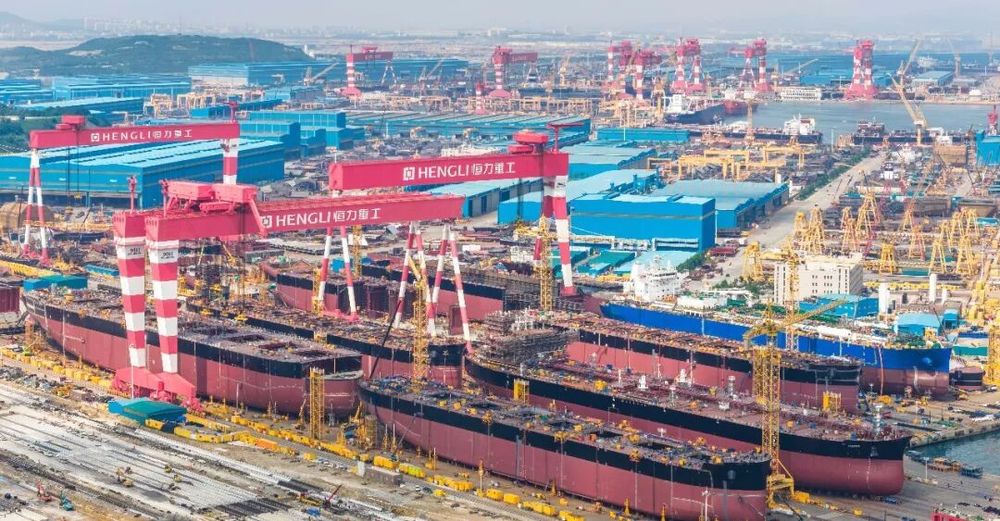
Hengli Heavy Industries currently has an annual steel processing capacity of 3 million tons and an annual production of 300 marine engines. Its four main dry docks allow for the simultaneous and batch construction of Very Large Crude Carriers (VLCCs) and ultra-large container ships (with capacities exceeding 10,000 TEU). In early June, the company revealed that approximately 30 mega-ships were simultaneously undergoing outfitting.
Following the completion of three capacity expansion projects, representing a total investment of 13.5 billion yuan, the company will have 22 shipyards capable of simultaneously building ten vessels under 200,000 deadweight tons (DWT) and 12 vessels over 200,000 DWT.