• 4 min de lectura
• 4 min de lectura
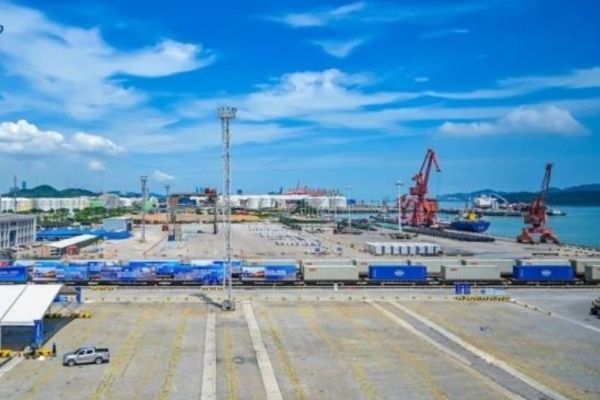
A train loaded with containers departed from the Yuanhai Terminal of Xiamen Port, marking the official opening of the terminal's dedicated railway line. This specialized line features a design perpendicular to the coastline and direct access to the quay, aimed at resolving the issues of lengthy operational processes in traditional sea-yard-rail intermodal transport, thereby further improving transport efficiency.
The dedicated railway line has a total length of 1,586 meters, with a design capacity for handling 250,000 TEUs and 250,000 tons of general cargo annually, making it among the first group of key projects for the integrated development of logistics and transport in China.
The railway track is laid at a right angle to the coastline and extends into the central operational area of the terminal, just 70 meters from the quay front, allowing goods to be loaded and dispatched directly.
On the same day, the inauguration ceremony of the dedicated railway line of the Xiamen Yuanhai Terminal and the Product Promotion Conference for the Supply Chain of the Cosco Shipping Group in the Fujian region were held simultaneously.
Authorities from Fujian province and Xiamen city, government departments at all levels, port control agencies, executives from Cosco Shipping Group, China Railway Nanchang Group, Cosco Shipping Ports Limited, as well as business partners from various sectors, attended and witnessed the milestone of the inaugural journey.
Duan Zongbei, head of the Commercial Department of Yuanhai Terminal, stated that "previously, when a container was unloaded from a ship, it was necessary to transport it by external container trucks to a railway station outside the port, located about 20 kilometers from the terminal, which generated additional towing and double lifting costs. With the opening of this dedicated railway line, cargo can be loaded onto the train and dispatched directly at the terminal, achieving a seamless sea-rail intermodal connection. Generally, comprehensive logistics costs can be reduced by over 15%, and the total logistics time can be shortened by two to three days."
This dedicated line, perpendicular to the coastline, transforms the old three-stage transfer (train-storage yard-ship) into a direct two-phase connection, which not only eliminates intermediate transshipment steps and costs but also significantly reduces the risk of cargo damage.
At the same time, the integrated innovation model of the Xiamen Yuanhai Terminal was officially implemented, eliminating information barriers between the port and the railway to allow for coordinated formulation of operational plans and unified allocation of equipment and resources.
Lin Xueqing, manager of the Marketing Department of Fuzhou Railway Logistics Center, said that "railway and port operational staff work simultaneously on this dedicated line. By combining train loading and unloading data with ship berthing information, we achieve data sharing and interconnection, which greatly increases efficiency and eliminates intermediate waiting times."
Zhang Jinyang, head of the Operations Department of Xiamen Yuanhai Terminal, added that "regarding the system, we implemented our railway module. This automatically connects with railway information for task transmission, and can also automatically assign and schedule equipment and container positions for rapid loading and unloading operations upon train arrival."
The Yuanhai terminal is one of the core port areas of Xiamen Port, with 21 trunk ocean routes covering regions such as Europe, America, and the Middle East, in addition to connecting with multiple railway corridors to inland provinces like Jiangxi, Hubei, and Sichuan. This newly opened railway line is open to the entire society and will attract more goods from the interior of the country to reach global destinations through the port.
To further optimize transport and customs clearance efficiency, various agencies such as the port, railway, and customs broke down barriers and collaborated in a coordinated manner, moving from fragmented operations to comprehensive and unified operational management.