• 3 min de lectura
• 3 min de lectura
Some of Denmark's largest batteries will be installed in the ports of Aarhus and Sjaellands Odde, two enormous energy storage systems that will form the core of the ecological transition of fast ferries for the shipping company Molslinjen, which selected BOS Power for their construction.
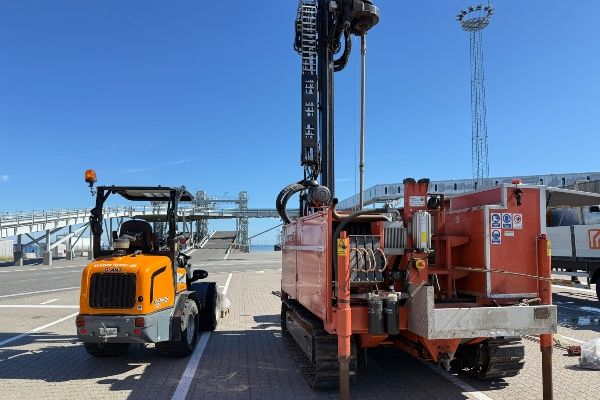
Preliminary studies have already begun in the Port of Aarhus, where test drills will determine if the ground has the necessary bearing capacity for the foundation of these large storage structures.
BOS Power will be responsible for supplying both battery packages, which will guarantee the necessary energy supply for the future electric megacatamaranes that will cover the routes across the Kattegat.
The development process and the selection of the ideal supplier for these battery parks have been carried out in collaboration with experts from Hybrid Greentech, a firm that advised Molslinjen from the beginning of the project and will continue to participate until its final execution.
"Molslinjen's project is one of the most complex and ambitious energy storage developments we have participated in. There are no precedents in Europe for battery parks of this magnitude for maritime use. These port facilities are not mere infrastructure, but the very foundation for the Kattegat routes to operate with electricity. Identifying the right solution has required exhaustive technical advice," said Rasmus Rode Mosbaek, CEO of Hybrid Greentech.
Each of the two port battery systems will have a capacity of 118 MWh, ensuring that the large fast ferries can recharge at each stop. The charging process, lasting half an hour, will combine energy from the general electricity grid with that stored in the port batteries.
Upon connection, each of the new catamarans will receive a 15 kV AC charge at a power of 55,000 kW for 30 minutes, which is equivalent to an average of 25,000 kWh of energy transferred before its next journey.
"It is not always possible to charge directly from the electricity grid on every trip. Therefore, to ensure continuous availability of the necessary energy, we require these batteries as a backup and redundancy system. In them, we can store energy equivalent to three or four trips in case of problems with the grid supply," explained Carsten Jensen, CEO of Molslinjen.
The introduction of these catamarans in the Kattegat is consolidated as the largest maritime electrification project globally. The vessels are currently being built at the Incat shipyard in Australia, and the first of them is expected to enter operation during the spring of 2028.
For his part, Kim Strate Kiegstad, Head of Energy Storage at BOS Power, highlighted the strategic relevance of the work. "This ferry route is critical infrastructure. The Kattegat connection between Jutland and Zealand is a vital communication route for people and goods that depend on it daily."
"The electrification of vessels must be carried out without compromising operational reliability. Supplying energy storage in two coastal facilities as a single contractor, from design to grid-compatible commissioning, is a demanding task, and that is precisely BOS Power's specialty," added Kiegstad.
Once the three electric ferries are fully operational, an estimated reduction of 132,000 tons of CO2 per year is expected. The total investment for the vessels and associated land infrastructure amounts to more than USD 500 million.