• 3 min de lectura
• 3 min de lectura
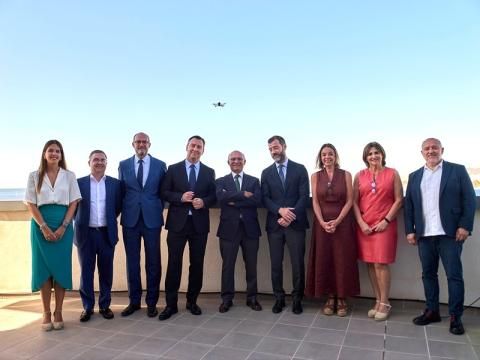
Puertos del Estado presented the guide for the use and application of unmanned aircraft systems (UAS) in the port environment, a project developed with port authorities and supported by other institutions, which offers a common reference framework to promote the progressive, safe, and coordinated integration of UAS.
The Secretary General of Air and Maritime Transport, Benito Núñez, highlighted at the inauguration of the presentation event that "drones are no longer an experimental element, but are part of our productive fabric, with applications in areas such as logistics, infrastructure inspection, agriculture, emergencies, and public services."
Núñez pointed out that these aircraft are capable of providing new operational solutions, by allowing access to places or performing tasks under conditions that previously presented greater limitations, reducing risks and costs, and improving resource availability. He also stressed that their development must continue to advance based on safety, efficient airspace management, and coexistence with other aeronautical and non-aeronautical uses.
The Secretary General valued the coordination work carried out in Spain to promote the deployment of UAS and remarked that the National Action Plan for the Deployment of U-space and its update, Pandu+, constitutes a clear and structured roadmap to continue addressing the deployment of drones in Spain in the coming years.
For his part, the President of Puertos del Estado, Gustavo Santana, emphasized that this initiative "demonstrates our commitment to innovation and the continuous improvement of the general interest port system."
Santana highlighted that this is the result of a collaborative process between port authorities, organizations, and entities linked to the aeronautical and regulatory fields, which "has allowed for the development of a practical, rigorous guide adapted to the real needs of Spanish ports and the regulatory context. This guide constitutes a starting point to continue advancing, in a coordinated manner, in the incorporation of UAS into the port system."
The President of the Port Authority of Malaga, Carlos Rubio, noted that "the launch of this guide comes at a critical moment and serves to cover a necessary standardization of procedures, inasmuch as the demand for the use of drones by port authorities as a method of public domain control, or by private operators for various commercial purposes, is growing very significantly."
The guide offers a comprehensive vision of the use of UAS in the port environment, addressing aspects related to governance, the regulatory framework, operation by Port Authorities, management of third-party operations, protection against non-collaborative UAS, main applications, and perspectives on the evolution of this technology.
According to Puertos del Estado, the use of drones is already a reality in numerous Spanish ports, where they are used in tasks such as perimeter surveillance and security, infrastructure inspection, topographic measurements, emergency management, and water surface control. These applications have demonstrated their capacity to improve infrastructure supervision, obtain operational information, environmental management, security, and response to different operational situations.