• 4 min de lectura
• 4 min de lectura
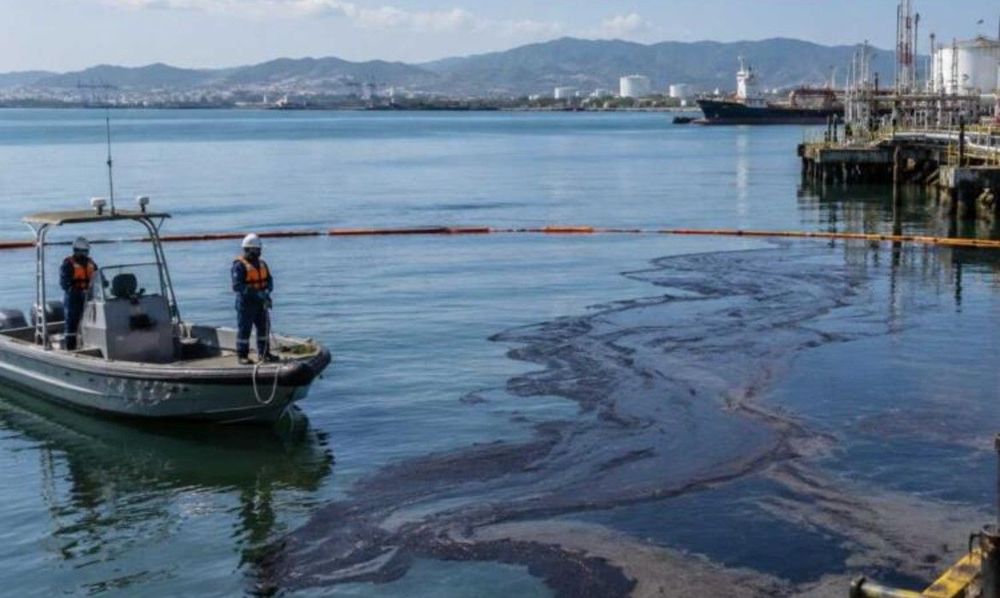
The presence of an oily slick in Manzanillo Bay mobilized maritime, port, and environmental authorities, as well as Petróleos Mexicanos (Pemex), who are investigating to determine the origin of the hydrocarbon detected on June 2 near the tourist pier and the State-owned company's Maritime Terminal.
According to the Secretariat of the Navy (Semar), the contingency led to the activation of the Local Contingency Plan for Spills of Hydrocarbons and Potentially Dangerous Noxious Substances in Mexican Marine Zones, after the National Port System Administration (Asipona) Manzanillo reported the presence of the pollutant in waters near the city's historic center.
The initial inspections carried out by specialized personnel allowed the identification of "dispersed patches of surface iridescence in the water," which concentrated around the perimeter barriers of the Pemex Maritime Terminal, a situation that triggered the application of response protocols to contain a possible environmental impact.
As part of the emergency actions, Semar deployed a joint operation with the Pacific Naval Force, the Fourteenth Naval Zone, and Asipona Manzanillo to carry out cleanup work and determine whether the presence of the hydrocarbon was due to an isolated event or a continuous source of contamination. The response included the deployment of 200 meters of containment booms from the Mexican Navy vessel "Comala," with the support of a tugboat, two Defender vessels from the Naval Search, Rescue, and Maritime Surveillance Station (ENSAR), and a Go Fast type vessel.
Asipona Manzanillo joined these actions by installing an additional 270 meters of barriers as structural support for containment efforts, in addition to another 450 meters placed at the Pemex Maritime Terminal. The naval authority specified that cleanup and hydrocarbon recovery efforts are ongoing, with the objective of preventing or mitigating damage to the marine ecosystem.
While containment tasks in the water progressed, Pemex reported that it maintains inter-institutional coordination to help identify the origin of the oily slick. The company indicated that personnel from the Federal Maritime Guard, Asipona Manzanillo, the Secretariat of the Navy, and the oil company itself conducted verification tours of docks, beach pipelines, and facilities of the maritime terminal.
As a result of the inspections carried out on June 2 and 3, Pemex assured that "the facilities are operating under normal conditions and without evidence of damage or incidents associated with the event," ruling out, for now, any indications directly linking the contingency to a visible failure in its infrastructure.
The company also reported that it maintains permanent coordination with the Secretariat of the Navy, Asipona Manzanillo, and other competent authorities to follow up on the investigations. Likewise, it announced a new pipeline inspection with the participation of the Secretariat of Environment and Natural Resources (Semarnat), the Federal Attorney for Environmental Protection (Profepa), Asipona, and Civil Protection, as part of the actions to clarify the origin of the hydrocarbon.
In its statement, Pemex reiterated "its commitment to environmental protection, the safety of its operations, and the timely attention to any situation that could represent a risk to the communities and ecosystems where it carries out its activities," while investigations continue.
For its part, the Secretariat of the Navy highlighted that the central purpose of activating the contingency plan is "to establish actions for the containment and recovery of the spilled hydrocarbon in the sea in the shortest possible time to prevent or mitigate damage and contamination to the marine environment." In this regard, the agency reaffirmed its commitment to the protection of the marine environment and the safety of port activities, in a contingency that authorities are keeping under observation while the origin of the substance that reached the waters of Manzanillo Bay is determined.