• 4 min de lectura
• 4 min de lectura
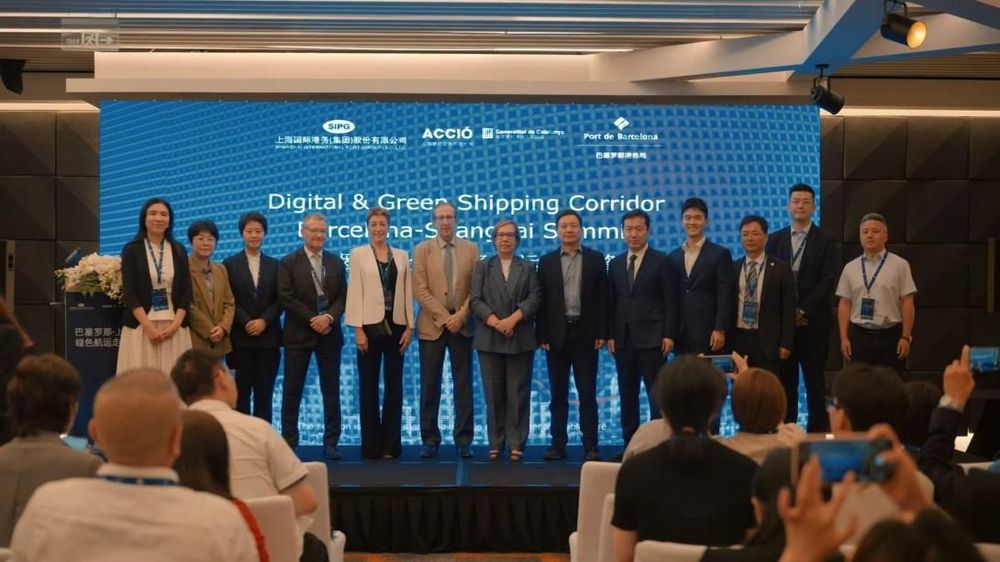
The green and digital corridor that will connect the Port of Barcelona and the Port of Shanghai has been one of the main highlights of the institutional and business mission organized by the Barcelona City Council in the Chinese city, in which several directors of the Port of Barcelona participated. The project to decarbonize and make maritime routes between both cities more efficient, promoted through an agreement between the two ports, focused the debate of the round table held on Wednesday in the Bund auditorium, Shanghai's most iconic promenade, overlooking its financial district.
The round table, jointly organized by the Port of Shanghai, the Port of Barcelona, and the Government of Catalonia, represented by ACCIÓ – Catalonia Trade & Investment, brought together institutional leaders, logistics operators, and industrial companies from both countries, and highlighted not only the development of the Green and Digital Maritime Corridor but also the economic collaboration between Catalonia and China.
The Deputy General Director and Head of Innovation and Business Strategy of the Port of Barcelona, Santiago Garcia-Milà, moderated the meeting, which also included executives from the automotive company Chery; from the shipping company AICC, specialized in Ro-Ro traffic; from the main automobile terminal of the Port of Shanghai; and from the oil company Repsol.
Participants, representatives of the main sectors involved in the deployment of such a corridor, highlighted the potential of projects like this to transform the maritime sector, advancing its decarbonization while improving operational efficiency, facilitating information exchange, and establishing shared regulations and protocols.
The Deputy General Director and Head of Commercial and Marketing of the Port of Barcelona, Carla Salvadó, was in charge of closing the day, emphasizing the impact that initiatives like this have on the energy transition process in logistics beyond the maritime scope and on improving competitiveness for clients of both ports. "When we talk about a green corridor between two ports like Barcelona and Shanghai, we are not just referring to making the ship journey more sustainable. We are talking about emission-free logistics from the factory to the final destination, and that involves all actors involved. And this is where ports have a key role as promoters and facilitators of this green logistics, which will make our clients more competitive," summarized Salvadó.
The Green Shipping and Digital Corridor between both ports has been one of the highlights of the growing relationship between the Port of Barcelona and the Port of Shanghai. This has intensified in recent years leading to the signing of a strategic agreement earlier this month during a visit by a Chinese delegation to Barcelona, which officially established the "sister ports" relationship between Shanghai and Barcelona.
This relationship, which frames the work for the establishment of the green corridor, is allowing progress on key elements for its implementation, such as aligned protocols and regulations regarding the supply of alternative fuels or the electrification of docks, as well as the decarbonization of land logistics.
For the Government of Catalonia and ACCIÓ, the Barcelona–Shanghai Green and Digital Maritime Corridor is much more than a logistics initiative. It acts as a platform to strengthen economic ties between Catalonia and China, facilitate new investment opportunities, and promote collaboration between companies, ports, and innovation ecosystems in both territories.
Currently, Catalonia hosts more than 200 Chinese companies in sectors such as automotive, mobility, technology, electronics, logistics, renewable energy, and e-commerce. Through its offices in China and its China Desk, ACCIÓ continues to support Chinese companies wishing to establish or expand their operations in Southern Europe, while fostering strategic alliances between Catalan and Chinese actors.
Close collaboration between the Port of Barcelona and ACCIÓ – Catalonia Trade & Investment plays a key role in strengthening Catalonia's international positioning as a leading logistics, industrial, and innovation hub in Southern Europe. Both organizations work jointly to promote Catalonia abroad, attract and support foreign investment projects, and foster long-term relationships with international companies already established in the territory.
This collaboration is especially relevant in Asia, and particularly in China, where the Port of Barcelona and ACCIÓ actively collaborate to publicize Catalonia's competitive advantages, facilitate new business opportunities, and attract strategic investments linked to logistics, advanced manufacturing, mobility, technology, and sustainable industry. Initiatives such as the Barcelona–Shanghai Green and Digital Maritime Corridor further reinforce this shared commitment to build stronger economic ties between Asia and Catalonia, moving towards a more sustainable and connected global economy.