• 3 min de lectura
• 3 min de lectura
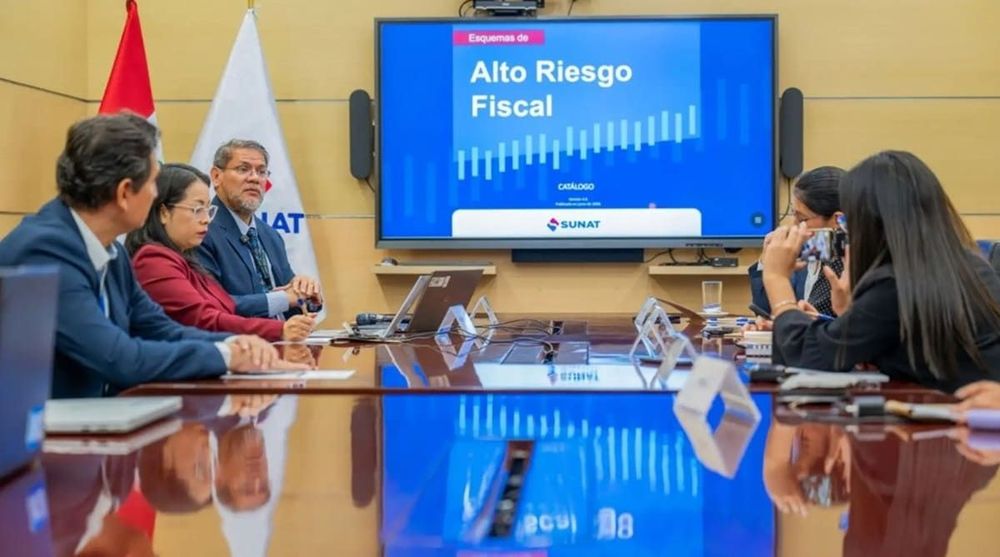
Sunat published version 4.0 of the Catalog of High Tax Risk Schemes, which includes 11 mechanisms that could be used to obtain undue benefits, thereby strengthening vigilance and prevention against practices that affect the integrity of the tax system.
This update is part of its commitment to promote voluntary compliance with tax obligations and in line with the strategic objective of improving tax compliance, specified the National Superintendence of Customs and Tax Administration (Sunat).
Diverse Situations
The National Superintendent of Strategies and Risk at Sunat, Carlos Rojas, detailed that the incorporated schemes describe situations of diverse nature that, according to their evaluation, could constitute cases of tax evasion, simulation, or improper use of tax benefits, making applicable, where appropriate, Rule XVI of the Tax Code, as well as specific anti-avoidance rules or the transfer pricing provisions regulated in the Income Tax Law.
He asserted that the purpose of updating the catalog is to provide taxpayers, tax advisors, academics, and the general public with preventive and guiding information, through a general identification and characterization of schemes considered high risk, with the aim of preventing their use and promoting timely and voluntary compliance with tax obligations.
Incorporated Schemes
The modalities incorporated into the catalog in its version 4.0 are the following:
Case Study
He explained that one of the incorporated schemes is called "Commercial credit line under the guise of loans from a Savings and Credit Cooperative." In this scheme, the company and its shareholders established a cooperative under their control, through which they offered their clients a card that allowed them to finance purchases made in their stores, with installment payments and interest.
Formally, clients were registered as members through minimal contributions, although without effective compliance with statutory requirements or participation in cooperative management. Payments of installments were made at the company's premises, while interest was declared as income by the cooperative.
In practice, the cooperative did not carry out real cooperative activity, clients were unaware of their status as members, did not intervene in the administration, nor did they receive financial education. Interest income was channeled through the cooperative as a tax intermediation mechanism, allowing the company to avoid paying 29.5% Income Tax (IR) and 18% General Sales Tax (IGV) applicable to commercial financing operations.
The main purpose of this structure was to obtain an undue tax advantage, explained the Sunat official.
Identified Cooperatives
In this regard, according to Sunat's database, approximately 40 Savings and Credit Cooperatives have been identified that hold about 31 million soles in granted credits, which reflects the operations carried out by these entities and the need for rigorous analysis to ensure compliance with corresponding tax obligations.